What Is Brand Safety? Examples, Meaning, and Why It Matters for Influencer Marketing
Key Takeaways
- Brand safety is the practice of ensuring your partnerships, placements, and creator relationships do not expose your brand to reputational, legal, or commercial damage.
- The most expensive brand safety failures share one trait: the risk was visible before the deal was signed - just nobody looked. In 2024, Doritos Spain terminated a creator partnership within 48 hours of launch after nine-year-old archived tweets surfaced - content that a full history audit would have found before any contract was signed (Fortune, 2024).
- Brand safety and brand suitability are different problems. Brand safety eliminates hard risk; brand suitability finds the right fit. Most crises are suitability failures dressed up as safety failures.
- Influencer marketing creates brand safety risks that programmatic ad tech does not cover - a creator’s 2019 post is not a display ad placement. It requires a different screening process.
- 42% of consumers will distance themselves from brands associated with influencer controversies, even after a public apology. (Sprout Social Pulse Survey, Q2 2024)
Brand safety is not a new idea. It is a new problem in an old category, one that most brands are still solving with tools built for a different channel.
In programmatic advertising, brand safety means your display ad does not appear next to hate speech or a breaking disaster story. The tools for that have existed since the mid-2010s. IAS, DoubleVerify, and Sprinklr have it covered.
In influencer marketing, brand safety means something harder: the human being who is endorsing your product has not - at any point in their years of public posting - said something that will make your brand look complicit. That is a different question, and almost nobody has built a real process to answer it.
This post covers what brand safety actually means, how it differs from brand suitability, the five risk categories that matter in practice, and why influencer marketing demands its own brand safety approach - one that starts before the first DM, not after the first screenshot goes viral.
What Is Brand Safety? The Definition
Brand safety is the practice of ensuring that your brand is not associated with content, contexts, or individuals that could damage your reputation, expose you to legal risk, or erode customer trust.
The term originated in digital advertising - specifically in programmatic display buying, where brands needed a way to prevent their ads from appearing next to inappropriate content on publisher sites. The Global Alliance for Responsible Media (GARM), a cross-industry body supported by the World Federation of Advertisers, established the most widely cited brand safety framework before its dissolution in August 2024. GARM defined 11 categories of harmful content that advertisers should avoid, ranging from hate speech and illegal content to sensitive social issues and misinformation. The framework remains the industry reference standard despite GARM no longer operating.
In influencer marketing, the definition extends beyond where your ad appears to who is delivering it. A creator who has posted discriminatory content, made false health claims, or built a following through bot-driven fraud is a brand safety risk, even if the specific post you commissioned is perfectly on-message.
What Is the Difference Between Brand Safety and Brand Suitability?
Brand safety is a binary threshold: does this content, context, or creator carry a risk that no reasonable brand should accept? Hate speech, explicit adult content, misinformation, and criminal association are brand safety issues. They are disqualifiers, not judgment calls.
Brand suitability is a spectrum: does this content, context, or creator actively align with your brand’s values, audience, and campaign goals? A creator who posts about alcohol culture may be perfectly brand-safe but completely wrong for a children’s nutrition brand. A fitness influencer might be suitable for a supplement brand but misaligned for a luxury home goods company.
The distinction matters because most brand safety crises are actually suitability failures. Nobody combed through three years of posts. Nobody asked whether this creator’s audience has the same values as the brand’s customers. The result looks like a brand safety incident - but the fix requires a suitability process, not just a harder safety filter.
Brand Safety Examples: What Goes Wrong
The most instructive brand safety case studies are not dramatic exceptions. They are ordinary failures, partnerships that looked fine on a follower count and a media kit review, until they weren’t. Three patterns come up repeatedly.
Archived content that nobody looked for
In March 2024, Doritos Spain launched a short promotional video called ‘Crunch Talks’ with Samantha Hudson, a Spanish singer with around 370,000 Instagram followers. Within 24 hours, posts from Hudson’s Twitter archive dating to 2015 had gone viral. Doritos terminated the partnership the same day, pulled all campaign content, and issued a statement. The entire cycle - campaign launch to full withdrawal - took less than 48 hours (Fortune, 2024).
The content in question was nine years old and written when Hudson was a teenager. A basic audit of her full social media history, including older Twitter posts, not just the Instagram account she was hired for, would have surfaced before any contract was signed.
Misrepresented charity partnerships and legal exposure
In late 2023, Italian influencer Chiara Ferragni - who at the time had nearly 30 million Instagram followers - faced regulatory action over a Christmas cake campaign with confectionery brand Balocco. The campaign implied that proceeds from cake sales would benefit a children’s hospital; Italy’s antitrust authority confirmed this framing was misleading and issued fines of more than €1 million for unfair commercial practices - a civil regulatory outcome that stands regardless of other proceedings. A separate criminal prosecution was brought and later acquitted in January 2026 (CNN, 2026). The acquittal did not undo the regulatory fines, the reputational damage, or the national legislation, dubbed the ‘Ferragni Law’, that the scandal directly produced.
For the brands that worked with Ferragni during and after the scandal, the reputational exposure was real regardless of their own involvement. When a creator’s name is attached to active fraud proceedings and national regulatory legislation, every brand deal in their active portfolio gets scrutinized.
Undisclosed sponsorships and FTC liability
A less visible but growing category: brands being held liable for creator campaigns that lacked required FTC disclosures. As of 2025, FTC civil penalties reach up to $53,088 per violation per post, not per campaign (FTC Endorsement Guides, 2023). In enforcement actions involving scripted or directed creator content, the FTC has increasingly targeted the brand rather than the creator. A creator posting without a clear ‘#ad’ or ‘Sponsored’ disclosure because the brief didn’t require it is a brand’s compliance failure, not just the creator’s.
Fashion Nova paid $10,000 in FTC civil penalties in 2024 for failing to require influencers to disclose paid partnerships. That figure reflects a small campaign. However, at scale, the same non-compliance stacks into seven-figure exposure across dozens of posts.
Why Brand Safety Works Differently in Influencer Marketing
The brand safety tools built for programmatic advertising are designed to answer one question in real time: is this page a safe environment for my ad? They classify content against a taxonomy, typically GARM’s 11 categories, and block placements automatically.
That architecture solves a placement problem. Influencer marketing is not a placement problem. It is a people problem, and people require a different approach.
The core difference is temporal. Programmatic brand safety acts at the moment of ad serving: if a page becomes unsafe, the next impression is blocked. In influencer marketing, your brand safety window is the period before the contract is signed. Once the post goes live, you cannot block it the way you block an impression. The equivalent of a real-time brand safety tool in influencer marketing is a full content history audit completed before any partnership is agreed.
The second difference is directional. A display ad appearing next to a problematic news article is an adjacency problem - your brand is near the content. A creator partnership is an endorsement - the creator is speaking for your brand. Audience perception treats those two relationships very differently. Adjacency can be explained; endorsement cannot be unwound as easily once the screenshot is out.
The third difference is scale of history. A webpage has a publication date. A creator’s TikTok account may contain three years of daily posts, comment replies, Duets, Stitches, and audio clips. The content that surfaces in a brand safety crisis is almost never recent. The Doritos Spain case involved tweets from nine years before the partnership. A scan of the creator’s current feed would have found nothing of concern.
The global influencer marketing industry reached $33 billion in 2026 and is projected to exceed $40 billion over the next two years (Influencer Marketing Hub, 2026). At that scale, with campaigns running across dozens of creators per quarter, a vetting process that depends on someone manually scrolling a feed is not a process. It is a gap dressed up as one.
Five Brand Safety Risk Categories Every Brand Must Screen
Different brands draw their risk tolerance lines differently. A DTC spirits brand and a children’s education platform are not applying the same criteria. But there are five categories where every brand, regardless of industry, needs a documented position before evaluating any creator.
1. Archived offensive content
The most common source of brand safety failures is content that predates the partnership by years. Slurs, derogatory posts, offensive humor, or comments on sensitive topics - posted across Instagram, TikTok, Twitter, YouTube, or older platforms - can surface at any point after an announcement is made. The trigger is usually the announcement itself, which motivates critics to go looking.
The key screening implication: reviewing recent posts is not enough. A brand safety audit needs to cover a creator’s full posting history across every platform they have been active on, not just the primary channel in their media kit.
2. Legal and regulatory exposure
Active legal proceedings, regulatory investigations, and compliance failures create direct exposure for brand partners. The Chiara Ferragni case is the clearest recent example: brands maintaining active partnerships with her during the Pandorogate investigation inherited the reputational association regardless of their own involvement. Separately, FTC non-compliance is increasingly treated as a brand liability, not just a creator liability. Enforcement actions for undisclosed sponsorships now carry penalties of up to $53,088 per violation, and recent cases have named the brand directly when the content was scripted or directed.
3. Audience authenticity
Fake follower counts and bot-driven engagement are both a ROI problem and a brand safety problem. Inflated metrics mean the reach you are paying for does not exist - and partnering with a creator running a bot-padded account associates your brand with deceptive practices. The FTC’s 2024 Consumer Reviews and Testimonials Rule explicitly banned the purchase of fake followers and reviews, adding regulatory weight to what was previously treated as an ROI-only concern.
The screening signal is straightforward: engagement-to-follower ratios well below 1% on accounts above 100K followers warrant further investigation. Sudden follower spikes, geographically inconsistent audiences, and comment sections dominated by generic phrases are secondary indicators.
4. Platform-crossing content
Content does not stay on the platform where it was posted. A creator active on TikTok, Instagram, YouTube, and a podcast carries four distinct posting histories, and a problematic post on any of them can resurface attached to your brand’s name. Older video platforms are particularly high-risk: a YouTube channel from 2017 may contain content the creator has since distanced themselves from but never deleted.
A 2026 peer-reviewed study from Cardiff Business School analysed 101 brand-related misinformation posts (48,821 comments) and found that influencer-driven misinformation does not just increase toxicity, but it reconfigures its nature, producing distinct patterns of audience antagonism that persist even after debunking. The study found that a creator’s audience environment itself can be a brand safety issue, independent of the creator’s own posts.
5. Misaligned charitable and cause claims
This is an underdiscussed category that has become more visible since 2023. Creators who have made public claims about charitable giving, cause partnerships, or social impact that cannot be substantiated - or that contradict documented reality - create a specific type of reputational risk. The damage is amplified when the brand’s own campaign involves any social or charitable angle, because the audience draws a direct line between the creator’s credibility on those issues and the brand’s.
The practical screening step here is a basic public record review: news coverage, regulatory filings, and community forums. This content rarely appears in a creator’s own feed, which is why it is the category most likely to be missed in a manual review limited to recent posts.
Where Brand Safety Actually Starts
Brand safety is a documentation problem before it is a technology problem.
The common thread across every well-documented brand safety failure - Doritos Spain, Chiara Ferragni’s brand partners, the Bud Light fallout - is not that the risk was unforeseeable. It is that no written document existed before any creator was approached that defined what risks the brand would and would not accept. Without that document, vetting is informal. Informal vetting is inconsistent. Inconsistent vetting is how a nine-year-old tweet ends a campaign in 48 hours.
Start with the document. Before running a creator search, before pulling any list from a platform, write down: what content categories are automatic disqualifiers for your brand, what topics require further review, and what your response protocol is if something surfaces after signing. One page is enough. The discipline of writing it creates the consistency that protects you.
Then match the process to the volume. If your team runs more than 10 creator partnerships per quarter, manual review of full post histories is not realistic - it takes 4 to 6 hours per creator under best conditions. That is where AI scanning tools pay for themselves: not by replacing judgment, but by making the depth of review your team would do anyway actually feasible at scale.
For a deeper look at how brand safety fits into the full influencer vetting process, see our guide to brand safety in influencer marketing.
Run your first creator safety check
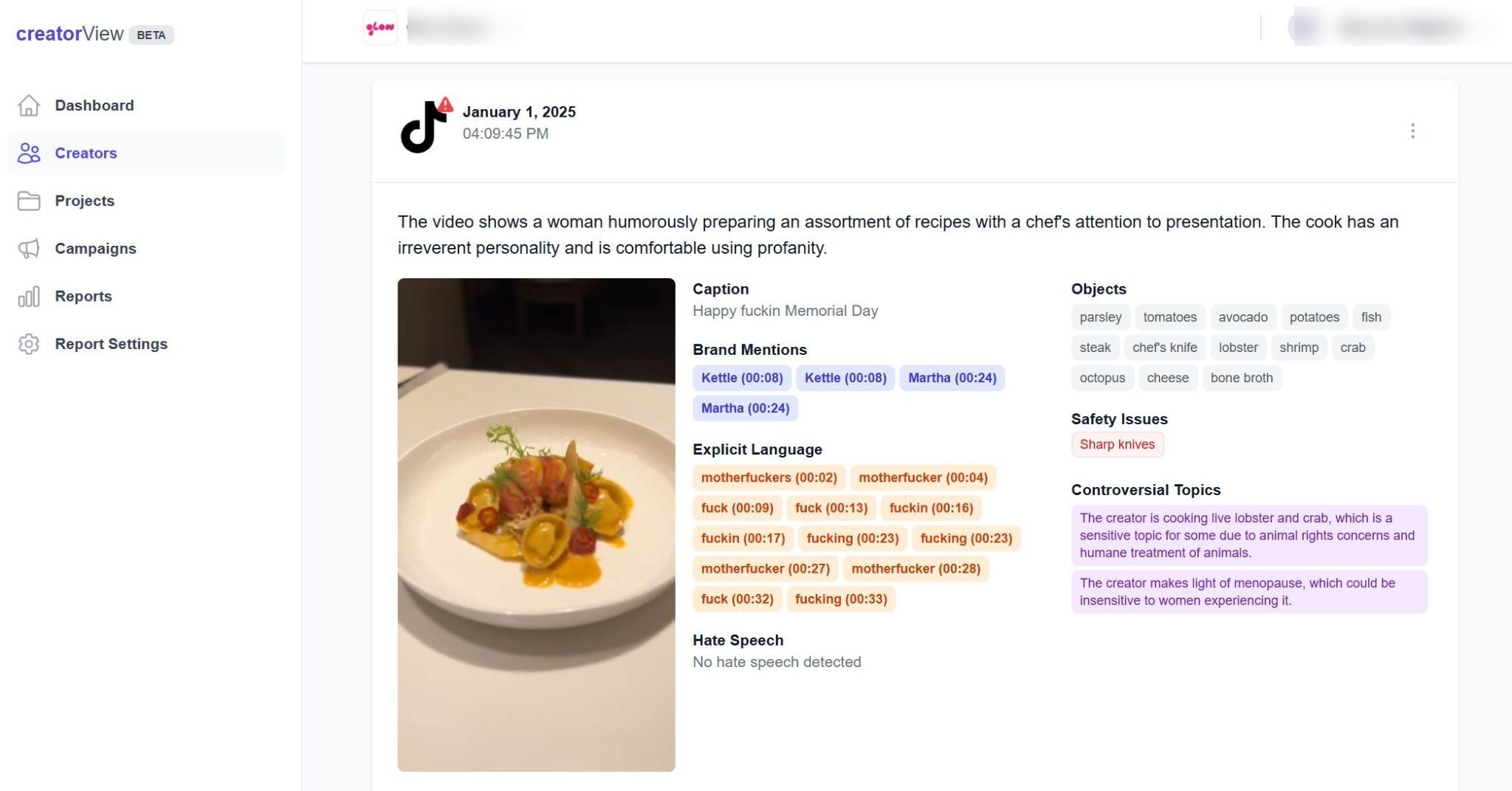
CreatorView scans a creator's full Instagram and TikTok post history in minutes - flagging controversial content, explicit language, hate speech, and reputational risks before you sign. No spreadsheets, no manual review, no surprises after the campaign goes live.
About the Author
The team behind CreatorView has spent 20+ years working at the intersection of influencer marketing and brand strategy, helping brands across retail, CPG, finance, and entertainment build creator vetting programs that scale without sacrificing due diligence.
About CreatorView
CreatorView is an AI brand safety platform that scans Instagram and TikTok creator histories to detect risk before partnerships launch. The platform surfaces controversial content, hate speech, explicit material, and reputational red flags in minutes - and produces a documented brand alignment report that serves as the foundation for every creator decision.
Frequently Asked Questions
What is the meaning of brand safety?
Brand safety is the practice of protecting a brand from reputational, legal, or commercial damage caused by association with harmful content, unsuitable platforms, or risky individuals. In digital advertising, it originally referred to ad placement - preventing display ads from appearing next to inappropriate content. In influencer marketing, it refers to the full vetting process applied before partnering with a creator, covering their content history, audience authenticity, and public record.
What is an example of brand safety?
The Doritos Spain case (2024) is one of the most instructive recent examples: posts from a creator’s Twitter archive dating back nine years surfaced within hours of a campaign launch, and the partnership was terminated the same day. Chiara Ferragni’s Pandorogate scandal shows a different failure mode - a charitable campaign that triggered a €1M+ regulatory fine and national legislation, with reputational damage extending to every brand in her active portfolio at the time. The Bud Light controversy (2023) demonstrated the same underlying pattern: in all three cases, the risk was visible in the creator’s public record before any contract was signed (CBS News, 2023).
What is being brand safe?
A creator is considered brand safe when their content history, audience quality, and public record do not carry material risk for the brand they are partnering with. Brand safety is brand-specific: a creator who is brand safe for a streetwear label may not be brand safe for a children’s food brand. The definition depends on the brand’s documented risk tolerance criteria, which should be established in writing before any creator is evaluated.
What is brand suitability vs brand safety?
Brand safety is a binary threshold - does this creator carry risk that no responsible brand should accept? Brand suitability is a spectrum - does this creator actively fit our brand’s values, audience, and goals? Brand safety failures are visible and often severe. Suitability failures are quieter but more common: the partnership that underperforms, alienates a segment of the brand’s audience, or generates low-level controversy because nobody asked the right questions before signing.
How do brands manage brand safety in influencer marketing?
Brands manage brand safety in influencer marketing through a five-stage process: (1) defining risk tolerance criteria in writing before evaluating any creator; (2) scanning the creator’s full post history across all platforms - not just their primary channel; (3) auditing audience authenticity using engagement metrics and third-party tools; (4) reviewing public record and media coverage; and (5) documenting every assessment for the creator’s file. For campaigns involving more than a handful of creators per quarter, AI-powered scanning tools reduce assessment time from hours to minutes. See CreatorView’s approach at creatorview.ai/features.