Brand Safety Monitoring for Influencer Campaigns: Before, During, and After
Key Takeaways
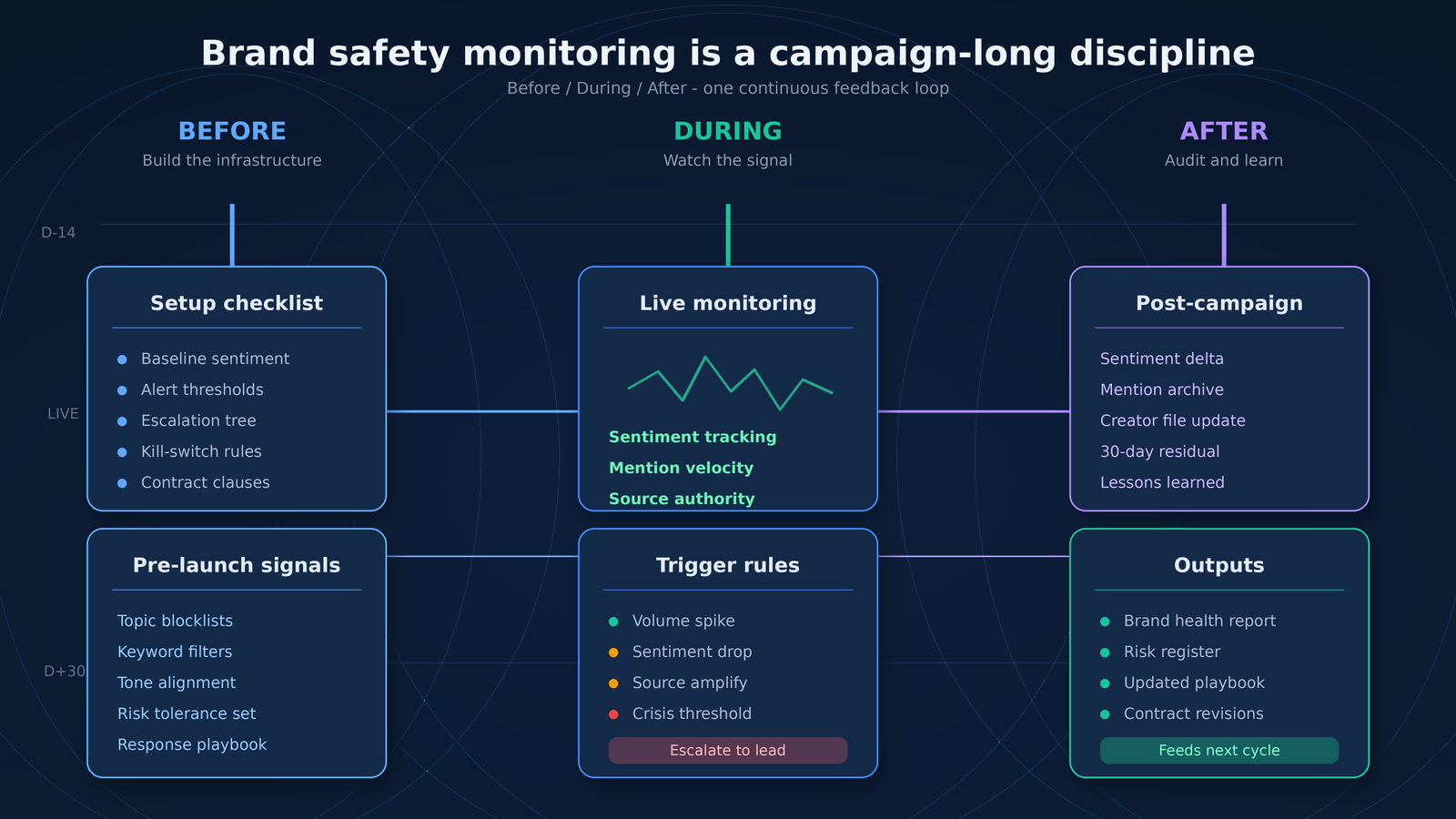
- Brand safety monitoring is not a phase - it is a lifecycle. The teams that get this right run continuous monitoring across three windows: setup (before launch), live signal tracking (during the campaign), and residual audit (for 30+ days after).
- The Influencer Marketing Association calculates that brands experienced average damages of $1.2 million per major brand safety failure in 2024, covering pull costs, legal fees, and lost media value (InfluenceFlow, citing IMA 2024).
- Negative sentiment now spreads roughly 40% faster than it did in 2022, according to the Global Digital Risk Report 2025. The window between ‘first signal’ and ‘public crisis’ is now measured in hours, not days.
- The ANA introduced its first-ever Brand Safety and Suitability metrics in November 2025, formalising monitoring as a discipline rather than a one-off audit (ANA, 2025).
- Most monitoring failures are not detection failures. They are escalation failures: the signal was visible, but no one knew who owned the response.
Most brands treat brand safety monitoring as something that happens after a campaign goes live. Listen for mentions, watch sentiment, react if something breaks. That is the bare minimum, and at modern campaign speeds, the bare minimum is no longer enough.
The window between an influencer-driven incident first surfacing and reaching mainstream coverage is now often under 12 hours. Brands that wait until live posting to start watching have lost the most valuable phase of the work: setup. The infrastructure built before launch determines whether a flag becomes a managed incident or a campaign-ending event.
This post covers brand safety monitoring as a complete lifecycle: what to set up before, what to watch during, and what to audit after. The structure applies whether you run two creator partnerships a quarter or two hundred.
Why Influencer Brand Safety Monitoring Got Harder in 2025-2026
Three shifts have changed the monitoring equation since 2024.
Sentiment now spreads roughly 40% faster than it did in 2022, according to the Global Digital Risk Report 2025. Monitoring cadences built around weekly check-ins were already late by 2024; hourly during active posting is closer to the practical standard now.
Platform signals also became less reliable. In October 2025, Meta launched new brand safety tools across Threads and Instagram with third-party verification through DoubleVerify and IAS, then withdrew from Media Rating Council brand safety audits in the same window. Brands cannot rely on the platforms alone to flag risk on creator content.
And monitoring became a measurable discipline. In November 2025, the Association of National Advertisers introduced its first-ever Brand Safety and Suitability metrics (ANA, 2025). Brands without a documented framework are now visibly behind a benchmark that did not exist 12 months ago.
Before: Build the Monitoring Infrastructure
Five things should be documented, agreed, and stored where the response team can reach them before a single creator post goes live. Skip this stage and the monitoring you do later is reactive, not structured.
1. A baseline sentiment snapshot
You cannot measure a sentiment shift without a starting point. Capture brand sentiment, share of voice, and branded conversation volume across the campaign platforms, plus the adjacent platforms where the conversation will spread. Two weeks of baseline is the minimum useful sample.
This snapshot also becomes the basis for measuring residual impact in the After phase. Without it, you can describe how a campaign felt; you cannot prove what it cost or contributed.
2. Trigger thresholds in writing
Decide in advance what ‘something is wrong’ actually looks like. Vague thresholds produce vague responses. For example: a 25% drop in positive sentiment over 6 hours triggers internal review; a 50% drop, or any mention by a verified account above 100,000 followers, triggers escalation; a regulator complaint triggers immediate response.
Document them. Approve them across marketing, legal, and PR before launch. The discipline of writing them down creates consistency under pressure.
3. An escalation tree with names on it
Most monitoring failures are escalation failures: someone saw the signal but did not know who to tell, or told someone without authority to act. Build a single page listing, by name and contact method, who owns each tier of response: the manager monitoring daily, the lead reviewing flagged content, the PR or comms head authorising public statements, and the legal contact for takedowns and contract enforcement. Agency and creator-manager contacts belong on the tree too.
4. Kill-switch criteria
Define the conditions under which the campaign stops. Not pause, not review - stop. A creator posting content that violates the agreed brand safety floor, a regulatory complaint, a credible threat of legal action: any of these should map to a pre-agreed termination. Writing this down before launch removes the in-crisis debate about whether a situation ‘really warrants’ ending the partnership.
The Influencer Marketing Association estimated average damages of $1.2 million per major brand safety failure in 2024 (InfluenceFlow, citing IMA 2024). A pre-defined kill-switch is the cheapest insurance against that number.
5. Contract clauses that match the playbook
Your contract is the legal foundation for everything monitoring needs to do later. Without explicit clauses, you have no standing to enforce takedowns, claim refunds, or terminate cleanly. Confirm before signing: content approval timelines, takedown rights with specified timeframes, indemnification, termination triggers tied to your kill-switch criteria, and post-campaign content usage rights.
For how this integrates with the broader vetting process, see our guide to brand safety in influencer marketing.
During: Watch the Right Signals at the Right Cadence
Live monitoring is where most teams over-invest in data and under-invest in decision-making. The point of During is not to track everything. It is to track the three signals that predict a brand safety incident, and act inside the response time defined in Before.
How often should you monitor brand safety signals during an active campaign? Active campaign monitoring runs on a tiered cadence: real-time alerting on threshold breaches, hourly content checks during peak posting windows, and a daily sentiment review meeting with the response team. This applies during the active posting period only; the cadence shifts to daily/weekly checks once posting concludes, and to weekly/monthly for the residual tail.
The three signals worth tracking continuously:
Volume of conversation
A spike in mention volume is the earliest signal. The spike itself is neutral - brand mentions also go up during a successful campaign. What matters is the rate of change relative to baseline. 3x baseline in an unscheduled hour deserves a look. 10x is a notification you should not be able to ignore.
Sentiment trajectory
Sentiment direction matters more than sentiment level. A campaign launching to mixed sentiment is normal; a campaign launching positive and then dropping sharply over a few hours is the most reliable predictor of an emerging issue. Alert on directional change, not absolute level.
Source authority
Negative sentiment from low-follower accounts is background noise. Negative sentiment from a verified journalist, a prominent account, or another creator with significant reach is amplification risk. Filter alerts by source authority so the response team sees the highest-reach signals first.
When a threshold trips, the response runs on the escalation tree built in Before. The job in During is to follow the playbook, not invent one. A brand figuring out who owns the response while the clock runs has already lost the timing battle.
After: Audit, Update, Feed the Next Cycle
The campaign ends; the brand’s exposure does not. Content stays up, clips circulate, sentiment shifts in the weeks after close. The After phase converts that residual signal into an updated baseline and a sharper playbook for the next cycle.
Sentiment delta versus baseline
Compare brand sentiment, mention volume, and share of voice in the 30 days after close against your pre-campaign baseline. The delta is the real measure of brand safety impact. A campaign that delivered strong engagement but lowered baseline sentiment had a hidden cost; one that finished without incident and raised baseline sentiment is the model to repeat.
Residual content monitoring
Posted content stays public; comments accumulate; screenshots circulate. Set a 30-day minimum residual window, longer for high-profile or multi-creator campaigns. Track whether sentiment continues to drift, whether new mentions tie the brand back in unexpected contexts, and whether flagged content has resurfaced.
This window is also where consumer behaviour signals show up. Deloitte’s 2025 brand resilience research found 61% of consumers return to brands that demonstrate visible learning from a creator-related controversy, compared to a much lower rate for brands that respond with silence or denial. The audit you produce in After is the input for that demonstrated learning.
Creator file update and contract retrospective
Every observation, flag, and escalation should land in the creator’s file by the end of After. The next vetting cycle gets cheaper because it starts with documented context rather than from zero.
Review the contract against what actually happened. If the takedown clause did not give you the timing you needed, revise it. If the kill-switch criteria triggered too late, rewrite them. The next contract should address every gap you found in this one.
Playbook update
Push every lesson back into the Before phase of the next campaign. New thresholds, refined escalation tree, updated contract clauses: all of it belongs in the playbook before another creator brief goes out. Monitoring is a loop; the After phase is what closes it.
What CreatorView Covers in This Lifecycle
CreatorView sits primarily in the Before phase, scanning a creator’s full Instagram and TikTok post history before signing and producing a brand alignment report that becomes part of the creator’s permanent file. That output feeds directly into the escalation tree, kill-switch criteria, and contract clauses the rest of the lifecycle depends on.
During and After, the brand alignment report is one input into a broader stack: social listening tools for sentiment and mention volume, PR monitoring for media coverage, and the response playbook your team built in Before. No single tool does all of it. See how the report integrates with your workflow: creatorview.ai/features.
Build the Loop, Not the Checklist
Brand safety monitoring fails when it is treated as a checklist applied once per campaign. It works when it is treated as a closed loop: every After audit becomes the next Before infrastructure, every During response becomes the next playbook revision, every flagged creator becomes a sharper signal for the next vetting cycle.
Brands doing this well are not investing more than their peers. They are investing more deliberately, and documenting the decisions the rest of the industry leaves to memory. That is what makes the discipline visible to senior leadership, defensible to legal, and survivable when an incident happens - because incidents will happen, even with the best process.
The question monitoring answers is not whether you will see the signal. It is whether your team will act on it before the public does. Start the loop in Before. Run it in During. Close it in After. Then start again.
Monitor every creator partnership automatically
CreatorView scans a creator's full Instagram and TikTok post history before the partnership is signed, surfacing the risk signals that should feed your monitoring playbook from day one. Every assessment is documented, shareable, and ready to plug into the rest of your monitoring stack.
About the Author
The team behind CreatorView has spent two decades inside agencies running creator campaigns, with practical experience building brand safety processes that actually survive contact with live campaigns. Their work focuses on translating that practitioner experience into systems that scale, covering brand safety, influencer marketing strategy, and creator due diligence for brands across retail, CPG, finance, and entertainment.
About CreatorView
CreatorView is an AI brand safety platform purpose-built for influencer marketing teams. It scans Instagram and TikTok creator histories to surface risk before partnerships launch, flagging controversial content, hate speech, explicit material, and reputational red flags, and produces a documented brand alignment report that becomes the foundation for monitoring, vetting, and creator decision-making across the entire campaign lifecycle.
Frequently Asked Questions
What is brand safety monitoring?
Brand safety monitoring is the continuous tracking of creator content, audience sentiment, and brand mentions across the full lifecycle of an influencer campaign. It runs in three phases: setting up the infrastructure (escalation tree, thresholds, kill-switch criteria) before launch; tracking volume, sentiment, and source-authority signals during live posting; and auditing residual impact for at least 30 days after close.
How often should you monitor brand safety during a live campaign?
Active campaigns run on a tiered cadence: real-time alerts on threshold breaches, hourly content checks during peak posting windows, and a daily sentiment review by the response team. It shifts to daily/weekly once active posting ends, and weekly/monthly for the residual tail. Negative sentiment now travels roughly 40% faster than in 2022 (Global Digital Risk Report 2025), so weekly-only during active campaigns is no longer defensible.
What signals should brand safety monitoring track?
Three signals predict most influencer-related brand safety incidents: conversation volume relative to baseline, sentiment trajectory (the direction of change, not the absolute level), and source authority (whether a verified account or notable creator is amplifying the conversation). Tracking all three together produces earlier and more reliable detection than tracking any one in isolation.
Who should own brand safety monitoring inside the brand?
Ownership is tiered. Day-to-day monitoring sits with the influencer or campaign manager. Threshold escalations route to a marketing or comms lead. Kill-switch decisions sit with a senior comms or PR head, with legal involved for contract enforcement. Document the names before launch; ambiguity is the source of every escalation failure.
How does brand safety monitoring connect to influencer ROI?
Risk-adjusted ROI is the real measure. A campaign delivering strong engagement but lowering baseline brand sentiment over the 30 days after launch has a hidden cost that gross attribution misses. Monitoring produces the sentiment delta needed to capture that adjustment.