Brand Safety AI: How Machine Learning Flags Creator Risk Before You Sign
Key Takeaways
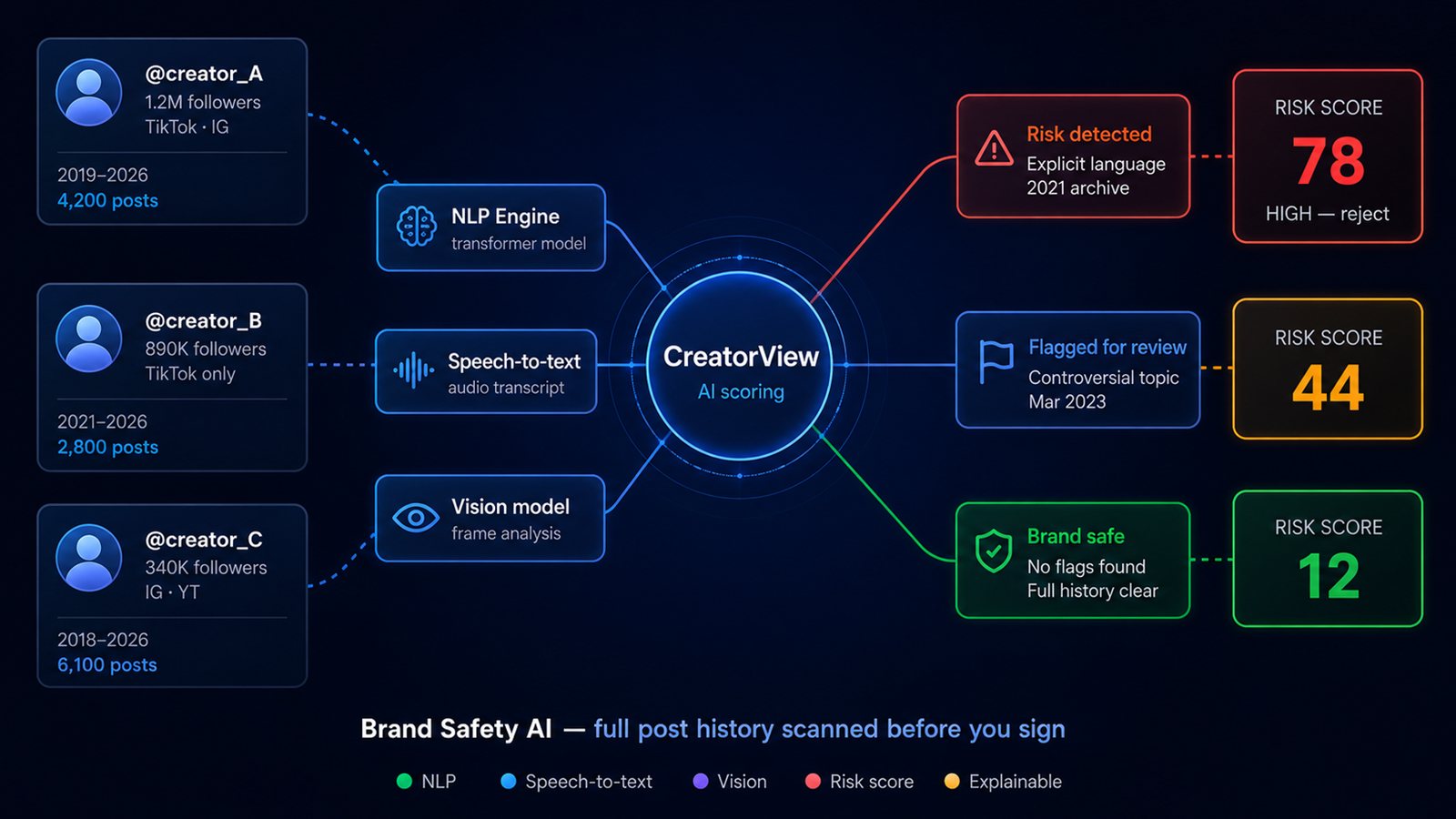
- Brand safety AI for influencer marketing is fundamentally different from programmatic ad tech. It scans a creator’s full post history - covering text, audio, and visual content - rather than classifying a webpage in real time.
- AI-powered vetting reduces influencer screening time by up to 70% compared to manual review, according to the Influencer Marketing Hub 2026 Benchmark Report. The time saving is real, but the accuracy depends on the models underneath.
- Keyword blocklists fail at scale because they cannot understand context. The word ‘shot’ in a cocktail recipe, a basketball highlight, and a violent incident carries identical weight to a keyword filter, but completely different brand risk.
- A 2026 peer-reviewed study found that AI brand safety classification systems frequently produce inconsistent results across providers, with safe content misclassified as unsafe - meaning human review of AI flags is not optional (arxiv, 2026).
- AI tools outperform human reviewers on depth and consistency: they apply the same criteria to a post from 2018 as to one from last week. Human reviewers prioritise recency by default, which is exactly where the risk often hides.
Brand safety AI is not magic. It is a stack of machine learning models: language classifiers, speech-to-text engines, and visual analyzers applied to a creator’s full posting history before your brand signs anything. The question is not whether AI helps with influencer vetting. It does. The question is what the technology actually does, where it works well, and where your team still needs to apply judgment.
Most brand safety AI currently deployed in ad tech was built to classify webpages for programmatic display advertising. That is a real-time, single-document problem. Influencer vetting is a retrospective, multi-modal, multi-year, multi-platform problem. They are not the same problem, and they should not be solved with the same tools.
This post explains how the underlying technology works, why it matters for creator partnerships specifically, and what a well-designed AI vetting workflow actually looks like - including where human review still belongs.
Why Manual Review Cannot Scale for Influencer Brand Safety
The practical problem is straightforward. A creator active on Instagram and TikTok since 2019 has produced between 2,000 and 8,000 posts, captions, comment replies, Stories, and video transcripts. A brand running 20 partnerships per quarter would need to review up to 160,000 individual pieces of content manually, every quarter.
In practice, most teams review 10-20 recent posts per creator and call it vetting. That is not a risk management process. It is a recency bias problem dressed up as due diligence. The content that creates real brand safety incidents is almost never recent. It is buried in 2019 archives, old comment threads, or audio from a podcast episode the creator hosted three years ago.
According to the Influencer Marketing Hub 2026 Benchmark Report, AI is now the leading tool applied during the creator vetting phase, with 36.67% of teams using it for discovery and vetting, up from near-zero in 2022. The adoption is not driven by novelty. It is driven by the math: at any meaningful scale, manual review is not a realistic option.
The case for AI is not that it replaces judgment. It is that it makes the depth of review your team would want - if time allowed - actually feasible.
How Brand Safety AI Actually Works: The Three Signal Layers
Purpose-built brand safety AI for influencer vetting operates across three signal types. Each requires a different model, and all three are needed for comprehensive coverage.
1. Natural Language Processing (NLP): reading what a creator writes
NLP is the text layer. A transformer-based language model (the same architecture underlying most modern AI assistants) reads captions, comments, bio text, and any on-screen text extracted by optical character recognition (OCR). The model classifies content against predefined risk categories: hate speech, explicit language, politically divisive statements, reputational risks, and misinformation.
The key advance in modern NLP is contextual understanding. Earlier systems used keyword blocklists: a banned word in any context triggered a flag. Transformer models understand that ‘shot’ in a cocktail recipe, a basketball highlight reel, and a violent incident are three different things. That contextual disambiguation reduces false positives substantially, though it does not eliminate them.
A 2026 study published in arxiv found that brand safety classification systems from different providers still produce inconsistent results on the same content, with safe posts flagged as unsafe and vice versa (arxiv 2601.01303). The implication: AI flags are a starting point for review, not a final verdict.
2. Speech-to-text: the audio layer that most tools miss
Video content on TikTok and Instagram Reels is audio-first. A creator who is careful in captions can say something completely different in the video itself. A manual reviewer watching 4,000 videos is not going to catch every spoken sentence. A speech-to-text model does.
Audio transcription converts spoken content into text, which the NLP layer then classifies. This is how a creator who has never used an explicit caption can still be flagged for consistently using slurs in speech. It is also how misinformation embedded in informal monologue - the kind that gets clipped and shared out of context - is surfaced before your campaign attaches your brand name to it.
TikTok is primarily an audio-driven platform. Any brand safety tool that only reads captions is missing the majority of the signal on TikTok.
3. Vision and frame analysis: what the camera captures
The visual layer analyzes video frames and images for content that creates risk independently of what is said or written. This includes explicit visual content, recognized symbols associated with harmful ideologies, and contextual associations - such as a creator frequently photographed with individuals under investigation.
Computer vision also supports brand mention detection. If a competitor’s product appears on-screen in a creator’s video, that is a relevant piece of information for your campaign planning, regardless of whether the creator ever mentions the brand by name in a caption.
Risk Scoring and Explainability: What a Flag Actually Means
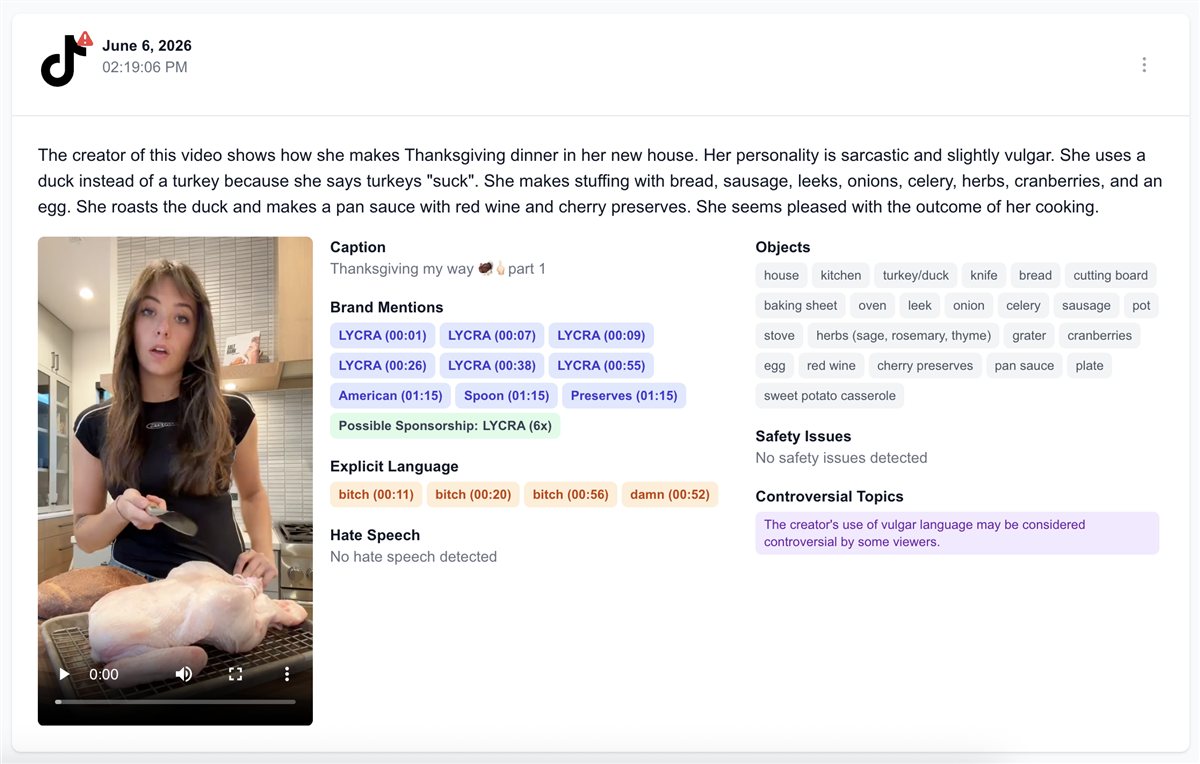
A risk score without an explanation is not useful. If a tool tells you a creator scored 74 on a risk scale and offers no evidence, you have no basis for a decision. You cannot take ‘74’ to a legal or compliance team. You cannot use it to brief a creator on what content to address before signing. And you cannot apply it consistently across different creators.
Well-designed brand safety AI is explainable: each flag links to a specific post, timestamp, or piece of content that triggered it. A flag for ‘explicit language’ should be accompanied by the exact posts where explicit language appeared, with timestamps in the case of video content. A flag for ‘controversial political content’ should point to the specific posts and provide the text or transcript.
This matters for two reasons. First, context changes decisions. A single explicit post from seven years ago is a different risk profile than consistent explicit content across the last six months. The AI flags the category; your team needs the evidence to make the call. Second, explainability creates accountability. A documented, evidence-backed vetting decision is defensible to internal stakeholders and external legal teams. A black-box risk score is not.
CreatorView surfaces risk flags with direct links to the source content and timestamps, so the team reviewing the assessment is reviewing actual evidence, not just a number. See how the output looks: creatorview.ai/features.
Where AI Brand Safety Has Real Limitations
An honest account of AI vetting includes its failure modes. These are not reasons to avoid the tools. They are reasons to structure the human review layer correctly.
Sarcasm, irony, and cultural context
NLP models struggle with irony, sarcasm, and culturally specific language patterns. A creator who consistently uses ironic language may trigger false positives. A creator who belongs to a cultural community with specific in-group terminology that appears offensive out of context may be misclassified. This is particularly common in Gen Z content, where irony and deadpan are the default register.
The implication is not that the AI is wrong. Every flag needs a human check before a decision is made. The AI narrows the review set from thousands of posts to the flagged subset. The human reviewers provide the contextual judgment the model cannot.
New creators with thin posting history
Brand safety AI performs best on creators with substantial posting histories. The signal-to-noise ratio is higher when there is more signal. A creator who joined TikTok in early 2026 with 200 posts has a thin history. The absence of flags in a thin archive does not mean the creator is risk-free; it means the tool has less material to evaluate.
For new or fast-growing creators, AI scanning should be supplemented with a public record review: media coverage, community forum mentions, and any prior brand relationships.
Cross-platform blind spots
Most AI vetting tools scan the platforms they are integrated with. A creator with a problematic YouTube channel from 2016 (not on the tool’s scanning scope) presents a gap. Before finalising any vetting assessment, confirm which platforms were scanned and manually check any platforms outside the tool’s coverage.
For a full list of the platforms CreatorView currently scans and what the assessment covers, see creatorview.ai/features.
The Human-AI Vetting Workflow: Where Each Layer Belongs
Brand safety AI works best as the first pass in a structured workflow, not as a standalone decision engine. Here is the sequence that applies the technology correctly:
-
Define your risk criteria in writing. AI tools flag against the categories they are trained on. If your brand has specific non-negotiables - competitor associations, certain political topics, country-specific sensitivities - document them before running any scan, and confirm your tool can flag against them.
-
Run the AI scan across all active platforms. This is the history review layer: NLP on captions, speech-to-text on video audio, vision analysis on frames. The output is a prioritised list of flags with evidence.
-
Human review of flagged content. Every flag should be reviewed by a person before a go/no-go decision. The AI narrows the review set and a human makes the call. This step takes minutes per creator when the flags are explainable and linked to source content.
-
Public record check. Search the creator’s name across news, Reddit, and creator-specific community forums. This surfaces reputational risks that do not appear in the creator’s own content - legal proceedings, documented controversies, organised harassment campaigns - and which no content scanning tool currently covers.
-
Document the assessment. Store the AI scan output, the human review notes, and the go/no-go decision in the creator’s file. This is your due-diligence record if a situation emerges after signing.
For a deeper look at how this process fits into the broader influencer vetting workflow, see our guide to brand safety in influencer marketing.
What to Carry Forward
Brand safety AI is the most practical answer to a structural problem: the volume of content a modern influencer produces makes manual review of full posting histories unworkable at campaign scale. The technology is ready. NLP models understand context, speech-to-text covers the audio layer that most manual reviews miss entirely, and vision analysis surfaces visual risk that no caption search would find.
The discipline is in the workflow. AI flags are the start of a review, not the end of one. Every flag needs a human check. Every assessment needs to be documented. And the criteria the AI is checking against need to be defined by your brand before any scan runs, because a tool that flags against the wrong categories is not protecting you - it is creating the appearance of protection.
The brands using AI vetting correctly are not the ones who handed the decision to the tool. They are the ones who used the tool to make their own judgment faster, more consistent, and more defensible.
For a full walkthrough of what brand safety means across the influencer vetting process, see our guide to brand safety in influencer marketing. For the specific AI capabilities CreatorView applies, see creatorview.ai/features.
Watch the AI scan in action
CreatorView scans a creator's full Instagram and TikTok post history in minutes using NLP, speech-to-text, and visual analysis to surface risk flags with timestamps and evidence. Every assessment is documented and shareable with your team before you sign.
Frequently Asked Questions
What is brand safety AI?
Brand safety AI is the application of machine learning models - natural language processing, speech-to-text, and computer vision - applied to classify content as safe or unsafe for brand association. In influencer marketing, it specifically refers to tools that scan a creator’s full post history across platforms, flag risk categories with evidence, and produce a documented assessment before a partnership is signed. It is distinct from programmatic brand safety tools, which classify webpages in real time for display ad placement.
How does AI detect brand safety risks in creator content?
AI detects brand safety risks through three signal layers. NLP models read and classify text content including captions, comments, and on-screen text. Speech-to-text models transcribe video audio for NLP classification. Computer vision models analyze video frames and images for visual risk signals. Each flagged item links to a specific post or timestamp so human reviewers can assess context before making a decision.
Is AI brand safety more accurate than manual review?
AI is more consistent and more comprehensive than manual review. It applies the same criteria across thousands of posts without fatigue or recency bias. But AI classification is not perfectly accurate: a 2026 peer-reviewed study found inconsistencies across providers when classifying the same content. The correct frame is AI and human review working together: AI performs the depth scan, human reviewers apply contextual judgment to flagged content.
What is the difference between brand safety AI and a keyword blocklist?
A keyword blocklist flags any post containing a banned word, regardless of context. A transformer-based NLP model understands that the same word carries different meaning in different contexts, reducing false positives while catching genuine risk that a blocklist would miss. Keyword blocklists were the standard approach before 2022; modern brand safety AI uses contextual language models that substantially outperform them on both precision and recall.
Does CreatorView use AI to scan creator content?
Yes. CreatorView scans Instagram and TikTok creator post histories using AI, detecting controversial content, explicit language, hate speech, and reputational risks, and produces a documented brand alignment report. The output links every flag to the source content so teams can review evidence directly before signing. See a full breakdown of the features at creatorview.ai/features.